
The Witch Trials Come to Substack
Do we burn their reputation if a flawed system declares them a witch

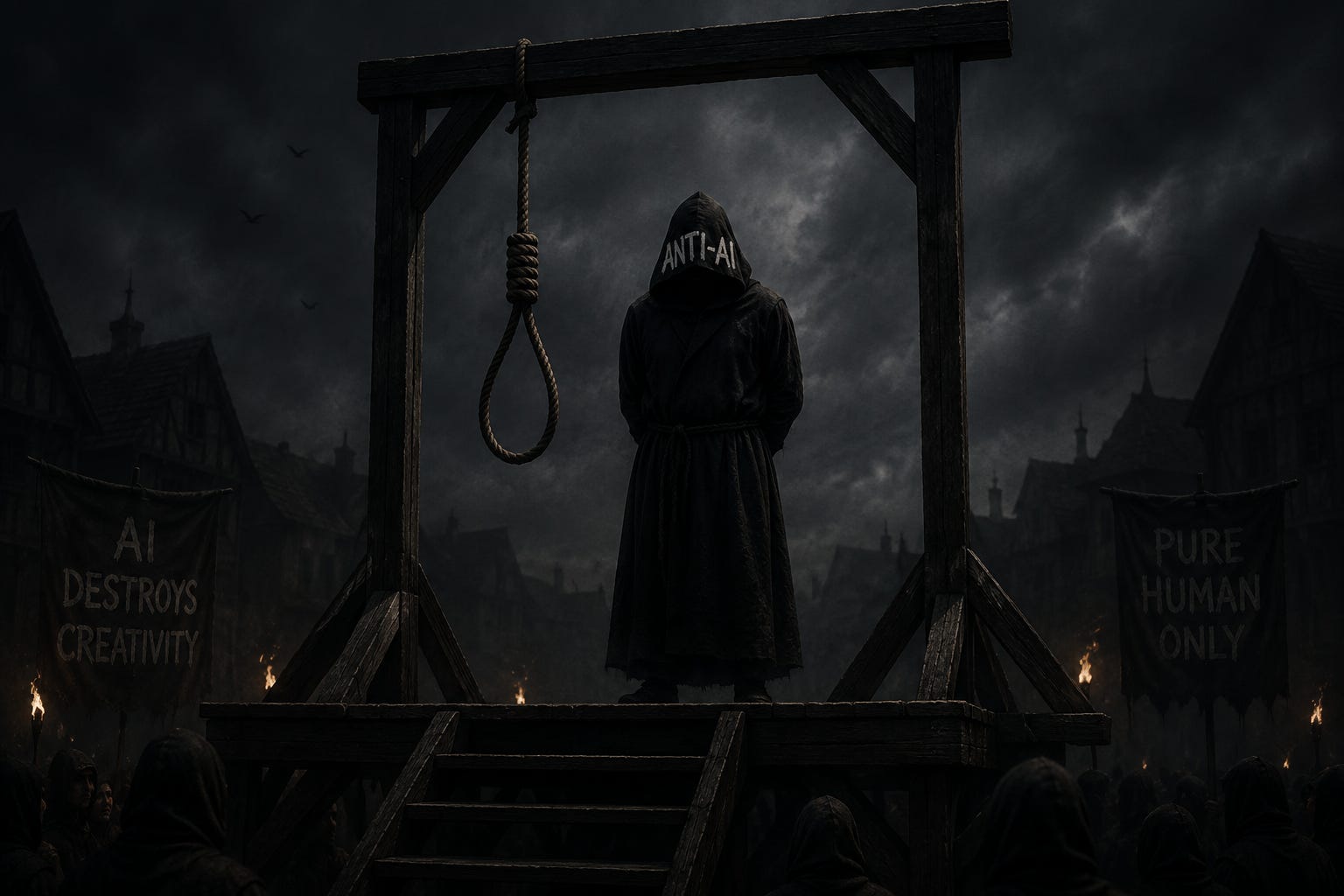
History has a way of returning, not wearing the same clothes, but asking the same questions.
No one is building gallows for writers. No one is marching authors through town. History almost never repeats itself that literally. But it often repeats its instincts.
The Salem witch trials were built on a terrible idea—an idea that hidden guilt mattered more than visible evidence. A person could live an ordinary life, deny every accusation, and still find themselves trapped beneath suspicion. The accusation itself became evidence. Defending yourself looked like guilt. Silence looked like guilt. Refusing the test looked like guilt.
I’m not a scholar on the Salem Witch trials, but I know enough to see the comparison. Many people have found themselves with that feeling, that they’re being so unfairly judged that they call it a witch hunt. There’s a cultural understanding of it because it is a human thing—judging others’ worth without so much as a trial.
In this case, the accusation has been made, and anything they choose to say is just more evidence of their impurity.
It’s just not every moment in history leads the judged to an execution. Sometimes it is the execution of a person’s reputation. Sometimes the execution of a lifetime of work.
It’s actually just destructive in my opinion.
Once a community begins hunting for invisible impurity, proving innocence becomes almost impossible. That is the pattern that keeps echoing in my mind.
Substack’s new AI detection button isn’t a gallows. It isn’t even a conviction.
It’s a scan.
Just a percentage.
Just a button.
But history teaches us that societies rarely change because of one dramatic event. They change because small ideas quietly reshape the culture. A button becomes a habit. A habit becomes an expectation. An expectation becomes a standard.
Eventually people forget there was ever another way.
For years, readers judged writing the old-fashioned way. They read it. If it moved them, it mattered. If it didn’t, it didn’t.
Now another question arrives before the first paragraph has even had a chance.
“How much of this was AI?”
Notice what disappeared. Not the writing. The writer. The conversation shifts away from whether the story is true, whether the ideas are thoughtful, whether the prose sings, and toward an investigation into the author’s creative process.
The work is no longer standing trial. The person is. And here’s what worries me most. I don’t think this culture is being driven by most readers.
Most readers simply want a good story.
Most readers don’t finish a novel with tears in their eyes and immediately wonder what software helped edit chapter twelve. Most readers don’t read an essay that moved them and made them feel seen, then automatically start wondering, Was it pure enough?
Most readers don’t spend their evenings investigating strangers. But online communities have always had something else. A loud minority. Every platform has people who appoint themselves gatekeepers.
They patrol. They announce departures. They celebrate block lists. They search for impurity because finding impurity gives them purpose.
The new scan button doesn’t create those people. It gives them a new instrument. Maybe the detector is accurate. Maybe it isn’t. Even if it were perfect, I think we’d still be asking the wrong question.
Because I know something about writing.
Some of my essays begin as conversations. Some begin as journal entries. Some begin as a single sentence that won’t leave me alone. Some are reshaped dozens of times before I publish them.
But every one of them comes from my own life, regardless of how much AI helped shape it. It is my life. It is as honest and sincere as writing can get.
It is my own life. My own ideas. Not just my grief, my faith, my failures, but my real life recovery.
But it is my imagination, my worlds, my characters—characters I created and love enough that I hurt when I make them hurt. Their hurt comes from my life. In many ways, my novels are a reinterpretation of the life that I have lived transformed into magical and mystical worlds.
No AI came up with my ideas. They are the truth of my life. AI didn’t live it. It couldn’t have.
AI helps me shape my ideas, but my ideas are my own. No AI created the storylines, they are my life and my imagination.
No AI manufactured the hell my life has been. It’s just helped me tell it in a compelling way. At times, I rely on it more than others.
When it comes to my novel, every word is mine. Every character has grown and developed alongside me and my writing. What began as immature, copy-and-paste dialogue from one character to another has become characters so true to themselves that you couldn’t imagine one speaking another’s lines.
AI didn’t do that. Twenty years of lived experience and growth of craft did that. Twenty years of living in this world. Whether I was actively writing it or not, it never left my mind.
That wasn’t AI.
That was me.
But I wouldn’t be surprised if some of my posts got flagged, even if I tell you about the night I almost gave up…
…that happened.
If I tell you about writing letters to my daughter…
…those letters exist.
If I tell you about schizophrenia, addiction, debt, hope, or God…
…I’m telling you my life as honestly as I know how.
The question that matters isn’t whether a machine ever touched the draft. The question is whether the person behind it is telling the truth.
That has always been the measure. And I hope it stays the measure. Because communities built on trust become places where people create. Communities built on suspicion become places where people perform innocence.
One produces writers.
The other produces defendants.
I know which community I want to belong to.
Couldn't agree more 💯